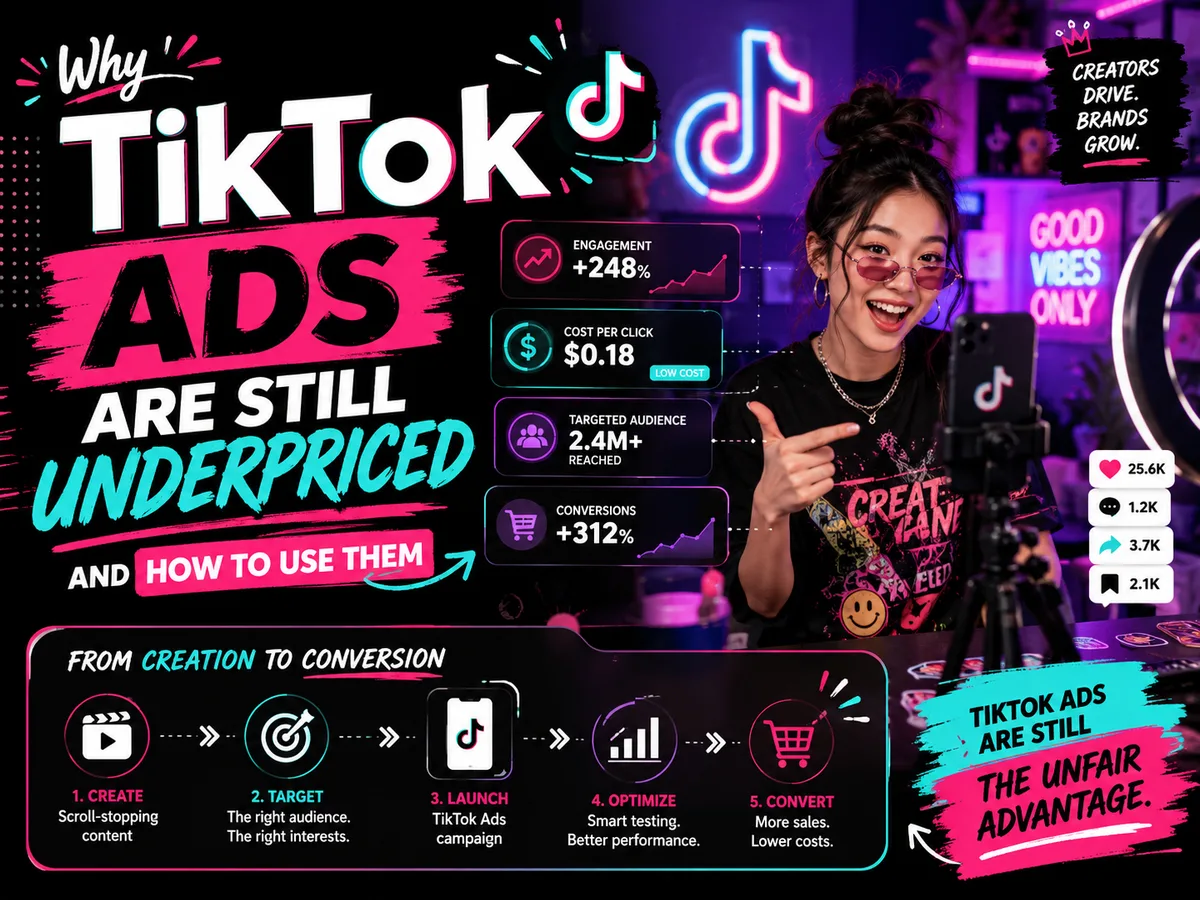
In most advertising markets, cost follows attention. When an audience is large and advertisers are competing heavily for access to it, prices go up. TikTok has a large and engaged audience, but advertiser demand has not yet caught up with that reach. The result is a cost-per-impression gap that, for the right kind of business running the right kind of creative, represents a genuine commercial opportunity.
Why the pricing gap still exists
TikTok's ad platform is younger than Meta's. When a platform is newer, it has fewer established advertisers, less auction competition and less historical data on which to train its optimisation algorithms. All of those factors push prices down relative to reach.
There is also a perception issue. Many businesses still associate TikTok primarily with teenagers doing dances, which causes them to dismiss it as an advertising channel without testing it. That hesitation has kept competition lower than the actual audience size warrants. The UK TikTok audience skews older than most marketers assume: a significant proportion of active users are in the 25 to 44 age range, which overlaps with the core demographic for many consumer products and services.
On Meta, you are bidding against millions of advertisers with years of campaign data, optimised creative libraries and substantial budgets. On TikTok, in most sectors outside of fast fashion and gaming, you are bidding against far fewer competitors. That asymmetry keeps CPMs lower, and it will not last indefinitely. Platforms mature, advertiser adoption grows and prices rise. The window of relative underpricing always closes eventually.
How the TikTok algorithm actually works
TikTok's algorithm is primarily content-driven rather than audience-driven. On Meta, you tell the algorithm who to show your ad to, and it finds those people. On TikTok, the algorithm watches how people respond to your content and decides who to show it to next. This is a meaningful difference for how you should approach creative.
If your video generates strong watch time, saves and shares in its first hours, the algorithm treats this as a signal that the content is valuable and extends its reach to a wider audience. If it generates low watch time and high skip rates, distribution is reduced quickly. This means creative quality is the primary lever, not targeting precision.
The implication for advertisers is that a video with a weak first two seconds will fail regardless of how good your targeting setup is. The hook matters more on TikTok than on any other platform. Users scroll fast, they have established patterns for recognising and skipping content that looks like an ad, and they reward content that feels useful, entertaining or surprising.
TikTok's Spark Ads format lets you boost organic posts as paid content. This is particularly useful because Spark Ads carry the post's existing likes, comments and shares, which provides social proof and makes the content look more organic. For businesses that already have some presence on TikTok, Spark Ads are often the most cost-effective entry point into paid promotion.
What kinds of businesses work on TikTok Ads
Ecommerce businesses with visual products tend to see the strongest results. Clothing, beauty products, food and drink, homeware, fitness equipment — anything where you can show the product in use, demonstrate a transformation or provoke an emotional reaction in under 15 seconds. The platform is well-suited to impulse purchases and discovery, less well-suited to considered, high-value B2B purchases.
Service businesses can work if the creative is right. A before-and-after video of a hair salon transformation, a restaurant showing the making of a signature dish, a personal trainer demonstrating a result — these formats transfer well from organic TikTok to paid ads because they use the same visual language the platform rewards.
The businesses that consistently struggle on TikTok are those selling complex, high-consideration services where the buying cycle is long and the decision involves significant research. IT services, professional advisory, industrial equipment — these categories have not found a reliable creative formula on TikTok, and the audience intent is not there in the way it is on search.
Campaign structure and budgets
TikTok's minimum daily campaign budget is £50. For a meaningful test of the platform, you need enough budget to accumulate data — typically four to six weeks of consistent spend before drawing conclusions. A budget of £500 to £1,500 per month is a reasonable starting point for most small businesses, enough to test two or three creative variations and understand which performs best.
Creative testing is more important on TikTok than on Meta because the algorithm is so sensitive to content signals. Running three distinctly different videos simultaneously and killing the weakest performer after two weeks is a more productive use of budget than perfecting a single piece of creative before launch. The platform rewards iteration.
Targeting on TikTok is less granular than Meta. You can target by age, gender, location and broad interest categories, but the kind of detailed interest-based and behavioural targeting that Meta offers is not available to the same degree. For most campaigns this is not a significant problem, because TikTok's content-driven algorithm does a reasonable job of finding relevant audiences without extensive targeting input, provided the creative signals are clear.
The creative rules that matter
Film vertically at 9:16. Any other format will either be letterboxed or cropped in a way that damages the viewing experience. The TikTok screen is the creative canvas and the video should fill it.
Hook within the first two seconds. The hook can be a question, a surprising claim, a striking visual or a direct address to a specific type of viewer. Whatever it is, it needs to stop the scroll before the viewer's thumb moves on. A slow introduction, a logo reveal or a brand statement at the top will cost you most of your audience before they see the message.
Keep it short. The sweet spot for TikTok Ads is typically 15 to 30 seconds. Longer is possible but only if the content sustains interest throughout. Most advertiser videos that run to 60 seconds lose the majority of their audience before the halfway point.
Use captions. A significant proportion of TikTok users watch without sound, particularly in public or work environments. Captions keep those viewers engaged and are quick to add in TikTok's own video editor before publishing.
The bottom line
TikTok Ads are not the right channel for every business. But for businesses selling visual products or services to consumers, the cost-per-impression advantage over Meta is real and the algorithm's ability to find relevant audiences based on creative signals rather than targeting precision is a genuine asset. The businesses that invest in testing TikTok now, while advertiser competition in most UK sectors is still relatively low, are building an advantage that will be harder to replicate once the market matures.
Ask AI about this topic
Get a personalised answer or ask a follow-up question about TikTok Ads for your business.
Frequently asked questions
TikTok's minimum campaign budget is £50 per day. CPMs typically range from £3 to £10 for most UK audiences, compared to £8 to £20 on Meta. The lower floor makes it accessible for smaller budgets, though meaningful testing still requires consistent spend over several weeks.
Ecommerce, food and drink, beauty and aesthetics, fitness, entertainment and consumer services all perform well. B2B is harder. The common thread is that products or services with a visual or emotional dimension tend to outperform those that are purely functional or complex.
Yes. Content that looks like a produced advertisement is typically ignored. The most effective TikTok Ads look like organic content: filmed on a phone, natural pacing, direct address to camera and a hook in the first two seconds. Production quality matters less than authenticity and a clear message.
The core concepts are similar: campaign objectives, audience targeting, ad sets and creatives. TikTok's targeting options are less granular than Meta's, but the algorithm compensates by being very effective at finding audiences based on creative content signals rather than demographic data alone.