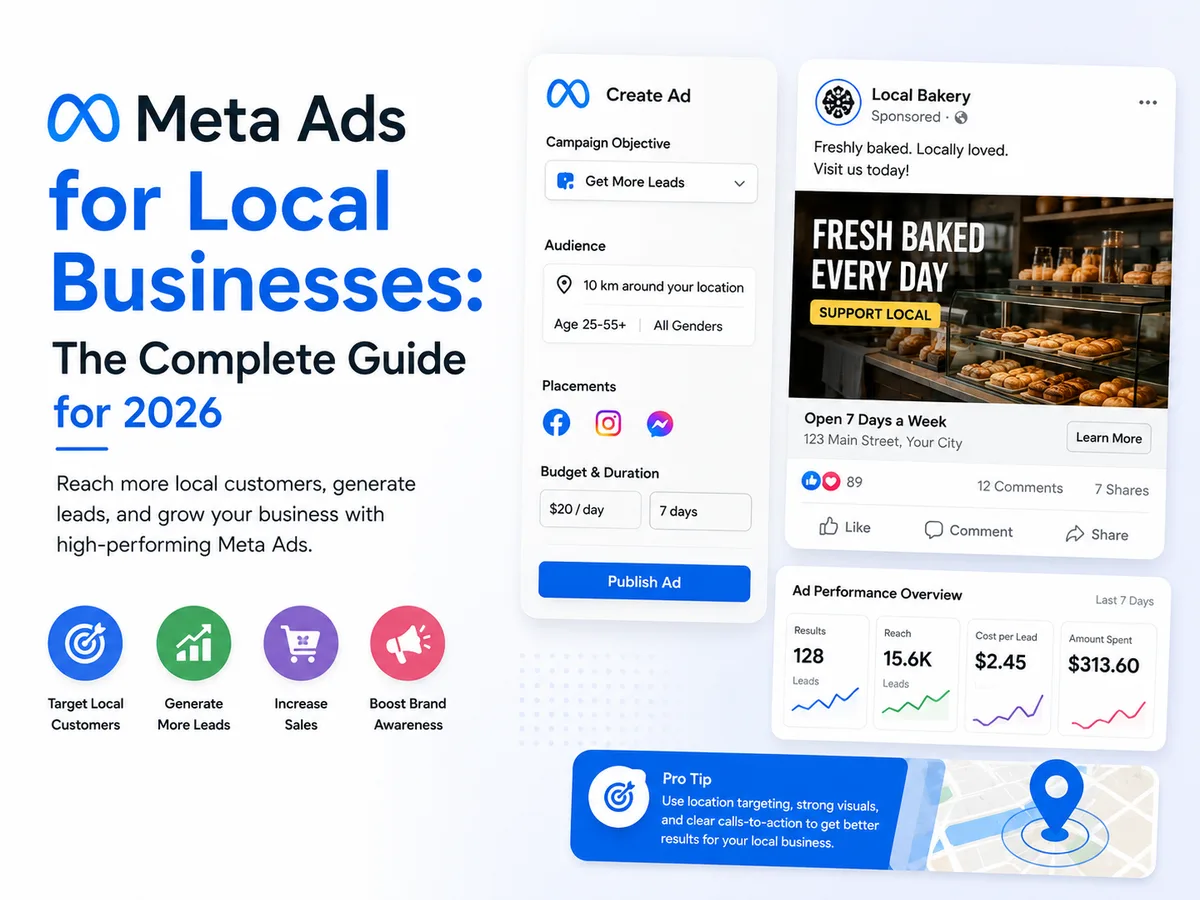
Meta Ads, the advertising platform that covers both Facebook and Instagram, remains one of the best-value advertising channels available to local UK businesses in 2026. The targeting options allow you to reach people in a specific postcode radius with demographic and interest filters that are precise. For a local business willing to put in the work to understand the platform, Meta Ads can produce a cost per lead that matches or beats Google Ads at a fraction of the competition level.
Why Meta Ads work differently from Google Ads
Google Ads captures demand, people searching for something they already know they want. Meta Ads create demand, reaching people who are not actively searching but match the profile of your ideal customer. This distinction matters significantly for how you structure your campaigns and what results you should expect.
A plumber running Google Ads waits for someone to search 'emergency plumber London' and bids to appear at that moment of need. The same plumber running Meta Ads might target homeowners within 10 miles of their location and show them an ad that generates awareness and trust before a problem occurs, so that when the burst pipe happens at 11pm, they call the number they recognise rather than searching Google from scratch.
The implication is that Meta Ads require more creative work and more patience than Google Ads. You are not capturing the bottom of the funnel, you are building it. The return on investment often takes longer to materialise but can be more durable once it does.
Campaign structure for local businesses
The campaign structure that works for most UK local businesses is simpler than most guides suggest:
One awareness campaign targeting your full potential audience with broad content, who you are, what you do, why you are worth considering. This might target people within a 10-mile radius with relevant demographic filters.
One retargeting campaign targeting people who have visited your website or engaged with your social content but not converted. This audience has already shown interest, the ads here can be more direct about taking action.
One conversion campaign targeting lookalike audiences built from your existing customer list. Meta's algorithm finds people who share characteristics with your existing customers, who are statistically more likely to be interested in your offering.
More campaigns than this are only necessary once you have proven the basic structure works and have the budget and creative resources to test additional variables.
Creative that actually works for local business ads
The creative that performs best for local business Meta Ads is almost never what looks most professional or most polished. It is content that feels genuine, local and specific.
Video consistently outperforms static images for most placements in 2026. A 15-to-30-second video showing your work, your team or your process outperforms a beautifully designed static ad in most local business categories. The bar for production quality is lower than most businesses assume, a steady phone camera and good natural light is sufficient.
Testimonials and social proof are among the highest-performing creative formats for local businesses. A short video of a real customer talking about their experience, even 20 seconds, even filmed on a phone in poor light, consistently outperforms produced content in local markets because it is credible in a way that advertising is not.
Local specificity helps. An ad that mentions a specific neighbourhood, references a local landmark or uses language specific to your area performs better in that area than a generic ad because it signals relevance to the viewer.
Budgets, costs and what to expect
Meta Ads for local UK businesses can produce meaningful results from £300 to £500 per month. This is enough budget to test a proper campaign structure, gather data and start optimising toward the ad sets and creatives that are working.
Cost per result varies enormously by sector. A local restaurant running awareness ads might spend £0.50 to £1.50 per post engagement. A cosmetic clinic generating enquiries might spend £8 to £25 per lead. A high-value service like kitchen installation or property development might spend £20 to £60 per lead from a cold audience but see those leads convert at a high enough value to justify the cost significantly.
The metrics that matter most are cost per lead and cost per customer, not cost per click or cost per impression. Many businesses optimise for the wrong metric and conclude Meta Ads do not work when the campaign was actually performing well on the metrics that matter.
Expect the first four to six weeks of any new campaign to be more expensive than later months. Meta's algorithm needs time to learn which users are most likely to convert. Stopping a campaign in the first month because early costs are high is one of the most common mistakes local businesses make.
The bottom line
Meta Ads reward businesses that commit to understanding the platform, invest in genuine creative and give campaigns enough time to produce data. The businesses that conclude Meta Ads do not work for them usually stopped too early, used poor creative or measured the wrong outcomes. At £300 to £500 per month with a clear structure and genuine creative, Meta Ads remain one of the best-value local advertising channels available to UK small businesses.
Ask AI about this topic
Get a personalised summary or ask a follow-up question about Meta Ads for Local Businesses.
Frequently asked questions
A meaningful test requires enough budget to gather data. £300 to £500 per month is a reasonable starting point for most local businesses. Below £200 per month it is difficult to gather enough data to optimise meaningfully.
Yes, particularly for local businesses. Facebook has the largest user base of any social platform in the UK across all age groups above 25. The targeting options for local audiences remain among the best available in digital advertising.
Use location targeting set to a radius around your business address or specific cities and postcode areas. Layer demographic filters (age, gender) if your customer profile is narrow. Use interest targeting to narrow your audience further if your product has a clear interest category.
Short video (15 to 30 seconds) consistently outperforms static images. Customer testimonial videos are among the highest-performing formats. Local specificity, mentioning your area, local landmarks or local events, improves performance in local campaigns.