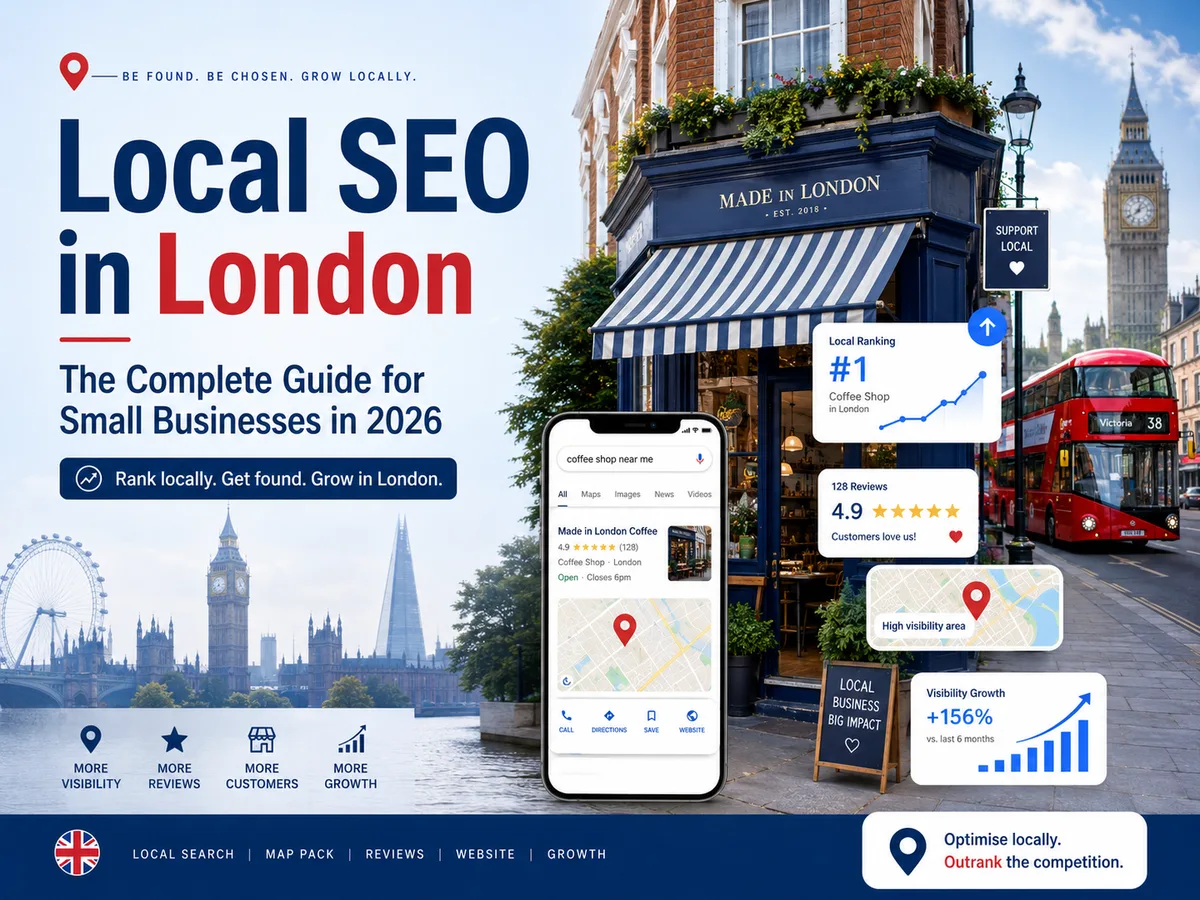
London has more than 1.1 million businesses and is the most competitive local search market in the UK. A Bloomsbury accountant, a Shoreditch coffee shop and a Kensington estate agent are all competing in a digital environment where the gap between ranking in the top three Google Maps results and not ranking at all can represent tens of thousands of pounds in annual revenue. This guide covers exactly what you need to do to compete.
Why London local SEO is different
In most UK towns, a reasonably well-optimised Google Business Profile and a handful of reviews will get you into the local map pack. London is different. In the most competitive central London sectors, restaurants, legal services, beauty treatments, financial services, you are competing with businesses that have spent years and significant budgets building their local SEO presence.
The neighbourhood dimension makes London SEO particularly nuanced. A business in Fitzrovia does not just compete for 'digital marketing agency London', it needs to rank for 'digital marketing agency Fitzrovia', 'digital marketing agency Bloomsbury' and similar neighbourhood-level terms. London consumers are highly location-aware and often search with specific area names rather than just 'London'.
Review volume and quality matter more in London than anywhere else in the UK. A restaurant in Manchester with 80 reviews and a 4.4 rating is competitive. The same business in Soho is invisible against competitors with 400 reviews and 4.7 ratings. The baseline expectations are higher.
Google Business Profile fundamentals
Your Google Business Profile is the single most important local SEO asset for most London small businesses. Here is what needs to be done:
Complete every field. Business name, category, address, website, phone, hours, attributes, service areas and description. The businesses that rank highest are typically those that have completed every available field. Leave nothing blank.
Choose your primary category carefully. Google uses this to determine which searches you appear for. If you are a restaurant, whether you classify as a 'Restaurant', 'Italian Restaurant' or 'Fine Dining Restaurant' affects which searches trigger your listing.
Post regularly. Google Business Profile posts signal to Google that your listing is active and managed. Two posts per week is sufficient. The content can be simple, a new menu item, a team photo, a promotion, a recent review.
Respond to every review within 24 hours. This applies to negative reviews as much as positive ones. How you respond to a critical review tells potential customers more about your business than the review itself.
Building reviews in a London market
Review generation is where most London businesses fall behind their most successful competitors. The businesses at the top of Google Maps in competitive London sectors did not get there by accident, they have systematic review generation processes that run continuously.
The most effective review generation method is also the simplest: ask every satisfied customer directly and immediately. Not via email a week later, not via a sign in your window, ask them directly, at the point of maximum satisfaction, and send them the Google review link on the spot.
For service businesses, the best moment to ask is at the end of a successful appointment or job. For retail, it is at the point of purchase when the customer is delighted. Remove every possible step between the request and the review, a shortened Google review link or a QR code on a card reduces friction significantly.
A London business adding five genuine reviews per month will outrank most competitors within six months. Adding ten per month will dominate most local searches within a year.
On-page SEO for London location pages
Your website needs to tell Google clearly which London areas you serve. This means location-specific pages rather than a single generic contact page listing your address.
A service business in Bloomsbury that serves clients across Central London should have specific pages targeting Bloomsbury, Fitzrovia, Marylebone, Islington, Shoreditch and other nearby areas. Each page needs original content that specifically addresses clients in that area, not just a template with the area name swapped in.
Schema markup, specifically LocalBusiness schema, communicates your location, service area and contact information directly to Google in a structured format. Most London small business websites do not have this implemented correctly, which represents a clear competitive advantage for those that do.
Page speed matters more in London than in most UK markets because London consumers have high expectations and low patience. A website that loads in under two seconds on mobile will convert better and rank better than one that takes four or five seconds.
The bottom line
London local SEO rewards consistency over shortcuts. The businesses dominating Google Maps in the most competitive London markets have typically been doing the same basic things well for two or three years: a complete and active Google Business Profile, a systematic review generation process, a well-structured website with location-specific content and good technical performance. None of these things are complicated. What separates the businesses that rank from those that do not is execution, not strategy.
Ask AI about this topic
Get a personalised summary or ask a follow-up question about Local SEO in London.
Frequently asked questions
For a new Google Business Profile with no reviews, expect four to eight weeks to see initial ranking improvements for less competitive terms. Competing for top-three positions in competitive Central London sectors typically takes six to eighteen months of consistent effort.
The number varies by sector and area. In most London neighbourhoods, 30 to 50 reviews with a rating above 4.5 is competitive. In Central London hospitality and professional services, the top-ranking businesses often have 200 or more reviews.
For businesses serving multiple London areas, location-specific pages help significantly. Each page should have original content addressing clients in that specific area, not just a template with the place name changed.
Google does not allow PO Box addresses and is increasingly sceptical of virtual office addresses used solely for Google Business Profile purposes. A genuine business presence at the address is required. Using a home address is permitted and does not need to be publicly displayed on the listing.