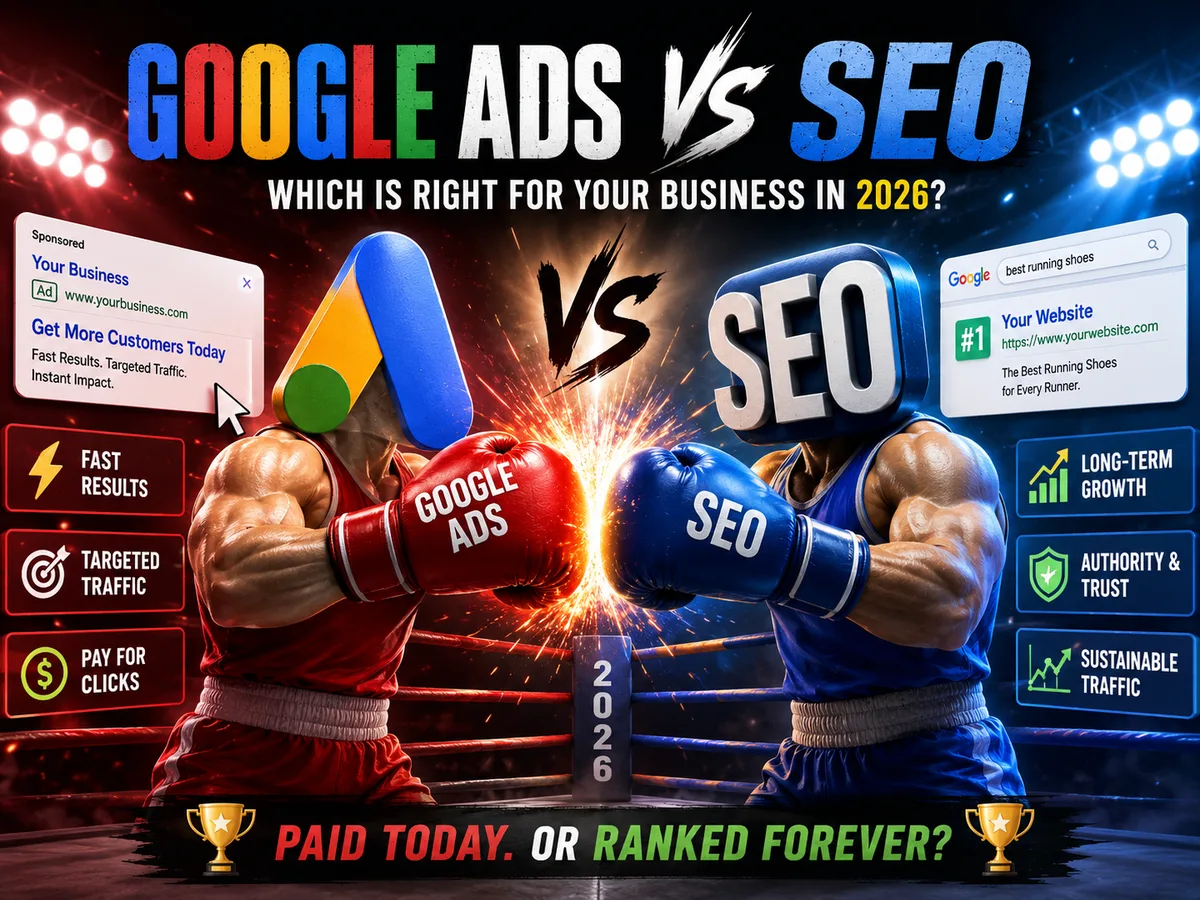
Most small business owners have asked this question at some point. You have a limited budget. You need more customers. Do you spend it on Google Ads or invest in SEO? The honest answer is that it depends on your situation, but the factors that determine the right answer are not complicated once you understand what each channel actually does.
What Google Ads actually does
Google Ads puts your business at the top of search results immediately. You pay for each click. Stop paying, stop appearing. The model is simple and the results are fast, a well-structured campaign can drive enquiries within 48 hours of launch. The cost varies enormously by sector. A solicitor in London might pay £8 to £25 per click. A plumber in Sheffield might pay £2 to £6. The key word is cost, Google Ads requires ongoing spend to keep working.
The quality of the clicks you get from Google Ads is generally high. People searching for your service right now, with buying intent, clicking your ad. The conversion rates from paid search are typically strong when the campaign is set up properly and the landing page is good.
Where Google Ads struggles is efficiency. Without proper account structure, negative keywords and regular optimisation, budgets drain fast with poor results. Most unmanaged Google Ads accounts waste 30 to 50 percent of their spend on irrelevant searches. This is the gap between a business that says Google Ads does not work for them and a business running well-managed campaigns.
What SEO actually does
SEO improves where your website appears in organic search results, the unpaid listings below the ads. Unlike Google Ads, you do not pay for each visitor. The tradeoff is time. SEO typically takes three to six months to show meaningful results for new websites, though improvements can appear faster for established sites being properly optimised for the first time.
The compounding effect of SEO is its major advantage over paid advertising. A well-optimised page can drive traffic for years after it was created. A Google Ads campaign that stops receiving budget stops driving traffic immediately. Businesses that invested in SEO five years ago are now receiving free traffic that would cost them thousands of pounds per month in Google Ads.
Local SEO, appearing in Google Maps and local search results, tends to produce faster results than national SEO. For a local service business, a properly set up Google Business Profile combined with good on-page SEO can produce visible improvements within four to eight weeks. This is often the most commercially valuable investment a local business can make.
The honest decision framework
Start with Google Ads if any of these apply to you:
Your business is brand new and has no organic presence. You cannot wait six months for SEO to produce results. Your product or service has a clear, short buying cycle where people search and buy quickly. You have a specific short-term campaign or promotion to run.
Start with SEO if any of these apply to you:
Your business has been running for more than a year and you have a website with some existing authority. You are in a sector where Google Ads costs are extremely high relative to your margins. You are building a long-term business and want to reduce dependence on paid traffic over time. You can invest consistently for six or more months before expecting significant returns.
For most small businesses with a modest budget, the right answer is local SEO first, followed by Google Ads once you have the organic foundation and can afford to test paid traffic without the campaign consuming your entire marketing budget.
The case for doing both
The businesses that grow fastest in organic search usually run some paid advertising as well, not because they need the traffic, but because Google Ads data tells you which keywords convert and which do not. You then apply that knowledge to your SEO strategy, focusing content and optimisation effort on the terms that actually produce customers rather than just traffic.
Conversely, businesses with strong organic rankings often run Google Ads on their most competitive terms to dominate the full page above the fold and capture searchers who click ads rather than organic results. The combination of organic and paid presence on the same search result page produces a significantly higher click-through rate than either channel alone.
The bottom line
Google Ads and SEO are not competitors, they are different tools for different stages of business growth. The business that starts with local SEO to build its organic foundation, then layers in Google Ads once it understands which keywords convert, will outperform the business that treats the two channels as an either/or decision. If your budget only allows one, match the channel to your situation honestly rather than what sounds most appealing.
Ask AI about this topic
Get a personalised summary or ask a follow-up question about Google Ads vs SEO.
Frequently asked questions
A well-structured Google Ads campaign can drive enquiries within 24 to 48 hours of going live. Results depend heavily on your sector, your budget and how competitive your market is.
For a new website targeting competitive terms, expect three to six months before significant organic traffic. Local SEO for a Google Business Profile typically shows improvements within four to eight weeks.
The basics of local SEO, completing your Google Business Profile, getting reviews, ensuring your website is mobile-friendly and fast, can be done without an agency. Technical SEO and content strategy benefit from expertise, particularly in competitive markets.
A meaningful test of Google Ads requires enough budget to accumulate data. In most UK local markets, £500 to £1,000 per month is a reasonable starting point. In highly competitive sectors like legal services or financial services in London, meaningful budgets start higher.