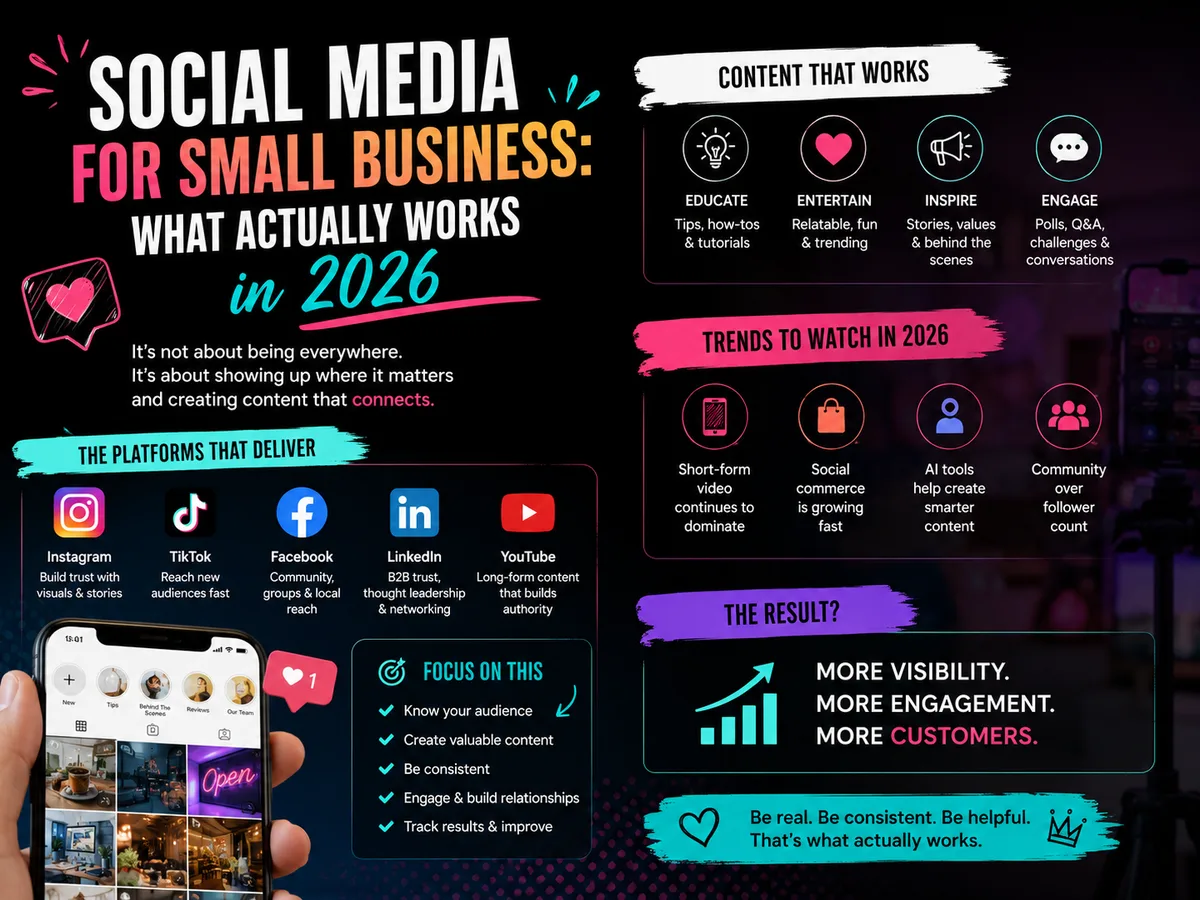
Social media advice for small businesses is dominated by content created for large brands with full marketing teams. Post daily. Use all the platforms. Build a community. Run competitions. The advice is not wrong in isolation, it is just irrelevant for a business where the owner is also the marketer, the salesperson and the service provider. Here is what actually produces commercial results when you have limited time.
Choose one platform and be good at it
The worst social media strategy for a small business is posting mediocre content across five platforms simultaneously. Spreading thin content across Instagram, Facebook, LinkedIn, TikTok and X produces poor results on all of them while consuming significant time.
The best platform for your business depends on where your customers actually are, not where you think they should be. A B2B professional services firm should be on LinkedIn and probably not on TikTok. A restaurant should be on Instagram and possibly TikTok. A trades business should focus on Facebook and Google Business Profile. A fashion brand should be on Instagram and TikTok.
Mastering one platform means understanding its algorithm, its content formats, its audience behaviour and its best practices deeply enough to produce content that actually gets seen. This takes months of consistent effort. Spreading the same effort across five platforms means you never develop the depth needed to succeed on any of them.
Content that drives results for local businesses
The content that drives the most commercial results for local small businesses is almost never the content that wins engagement competitions or looks most polished. It is content that demonstrates expertise, builds trust and gives potential customers a reason to choose you over a competitor.
Before and after content works in almost every sector where there is a visible transformation, cleaning, construction, hair and beauty, landscaping, car repairs. It is compelling because it is concrete evidence of the quality of your work.
Answering common customer questions works for service businesses. A solicitor answering common conveyancing questions, an accountant explaining Making Tax Digital, a personal trainer explaining how many sessions someone needs to see results. This content attracts potential customers who are actively researching and positions you as the expert.
Showing your process works for any business where the customer cannot see what you do. How you source ingredients. How you diagnose a plumbing problem. How you design a logo. Behind the scenes content builds trust by making your invisible work visible.
Posting frequency that does not burn you out
Consistent, lower-frequency posting outperforms inconsistent, high-frequency posting every time. Three posts per week that you maintain for a year will produce better results than daily posting that burns out after six weeks.
For most small businesses, three to four posts per week on a single primary platform is the right starting frequency. This is enough to stay visible in your followers' feeds and maintain algorithmic favour without consuming your entire working week.
Batch your content creation. Two hours on a Sunday afternoon can produce a week's worth of content for a business that has learned what types of content work for its audience. Trying to come up with content ideas in the moment, every day, is what leads to inconsistency and burnout.
Scheduling tools, including the native scheduling in Instagram, Facebook and LinkedIn, allow you to create content in batches and have it publish automatically. This is standard practice for small businesses that take social media seriously.
Measuring what matters
Engagement rate, the percentage of your followers who like, comment or share your content, matters more than follower count. A business with 500 engaged, local followers will generate more enquiries than a business with 5,000 followers who never interact.
For a local business, the metric that matters most is enquiries directly attributable to social media. Not likes. Not followers. Enquiries. Ask every new customer how they found you. Track this manually if you have to. The businesses that discover their Instagram is driving zero enquiries can redirect that time to channels that actually produce customers.
Conversions from social media typically require multiple touchpoints. Someone sees your Instagram post, visits your website, reads your Google reviews, then calls you. They will tell you they found you on Google. The social media contribution is invisible unless you are tracking the full customer journey.
The bottom line
Social media works for small businesses that treat it as a commercial channel rather than a creative outlet. Choose one platform, post consistently, focus on content that demonstrates expertise and builds trust, and measure results in enquiries rather than engagement. The businesses that succeed at social media are not the ones with the most followers, they are the ones that showed up consistently, shared useful content and made it easy for interested people to take the next step.
Ask AI about this topic
Get a personalised summary or ask a follow-up question about Social Media for Small Business.
Frequently asked questions
It depends on your sector. Facebook has the largest UK user base and is strongest for local service businesses and older demographics. Instagram works best for visually-led businesses in food, beauty, fashion and interiors. LinkedIn is essential for B2B professional services. TikTok has strong reach for younger audiences and creative businesses.
Three to four times per week on a single primary platform is sustainable and effective for most small businesses. Consistency matters more than frequency, three posts per week maintained for a year outperforms daily posting maintained for two months.
Meta Ads (Facebook and Instagram) can be highly effective for local businesses with budgets from £300 per month. The targeting options for local audiences are excellent. TikTok advertising is less mature but growing. Social advertising works best when combined with good organic content.
Follower growth follows content quality. Post content that your target customers find useful, interesting or entertaining. Use relevant local hashtags. Engage with other local businesses and customers. Consistent posting over six to twelve months produces sustainable follower growth.