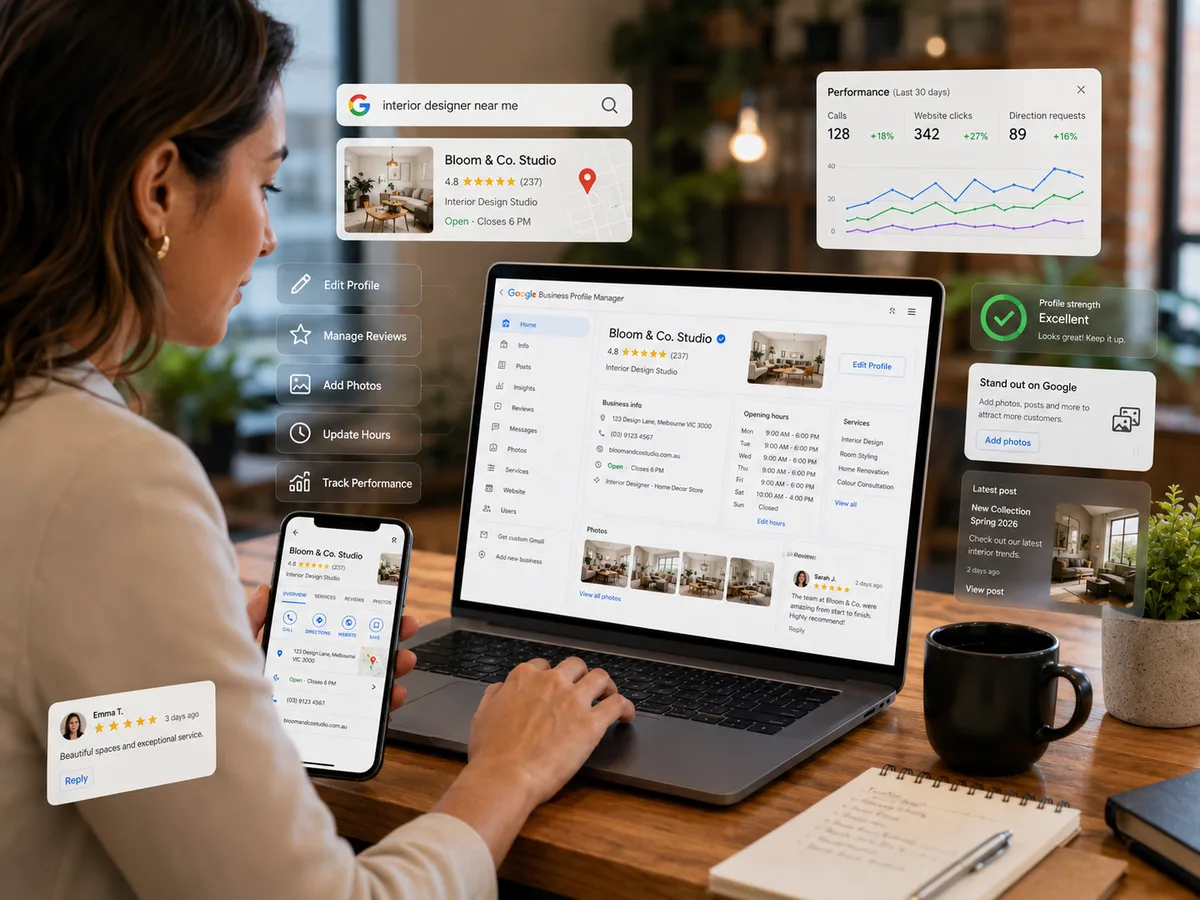
Before most people contact a business, they look it up. They check the Google reviews, scan the rating, read a few of the most recent comments and form a view in under two minutes. If what they find looks uncertain, they move on to the next result. Your online reputation is not separate from your marketing. For most local businesses, it is the deciding factor in whether an enquiry happens at all.
What online reputation management actually means
The phrase gets used to mean different things. For large companies, it often refers to suppressing negative press coverage or managing brand perception across multiple channels. For small businesses, it is more clear: it means making sure that when someone searches for your business name or your service in your area, what they find accurately reflects the quality of work you do and gives them enough confidence to get in touch.
That means three things in practice. First, generating enough genuine positive reviews that your rating and volume are competitive. Second, responding to reviews in a way that demonstrates professionalism. Third, monitoring what is being said about your business so you are not the last person to find out about a problem.
None of this is reputation management in the spin-doctor sense. It is just taking your online presence as seriously as you would take your physical premises. Most small business owners would not leave a sign in a bad state on the front of their shop. Leaving a Google Business Profile with a 3.8 rating and unanswered negative reviews from six months ago is the digital equivalent.
Why reviews matter more than most businesses realise
Reviews affect two separate things that are both commercially significant. They affect whether customers choose you, and they affect how high you rank in Google local search results.
On the customer decision side, research consistently shows that the majority of consumers read online reviews before visiting or contacting a local business, and that most people trust reviews as much as a personal recommendation from someone they know. A business with 4.8 stars and 120 reviews will attract significantly more enquiries from the same number of profile views than one with 3.9 stars and 14 reviews, holding everything else equal.
On the ranking side, Google uses review signals as one of the primary factors in its local ranking algorithm. The number of reviews, the recency of reviews, the average rating and the sentiment of review text all contribute. Two businesses with otherwise similar profiles will rank differently if one has a systematic review generation process and the other does not.
The compounding nature of reviews is worth understanding. A business that generates five new reviews per month will, after a year, have 60 additional reviews. A business that generates zero new reviews will still have whatever it had a year ago. In competitive local markets, that gap compounds into a significant ranking and conversion advantage over time.
Building reviews: what works and what does not
The method that produces the highest conversion rate for review requests is a direct, in-person ask at the moment of maximum customer satisfaction, followed immediately by a link. Not an email a week later. Not a sign in your window. A person, asking another person, at exactly the right moment, and then making it as easy as possible to act on that request.
For a dentist, that moment is when the patient is leaving after a successful treatment and saying how much better they feel. For a plumber, it is when the job is done, the customer is relieved and they are paying the invoice. For a restaurant, it is when the bill comes and the table has had a good night. Every business has its own version of this moment. The ones that identify it and build the ask into their process generate reviews at a rate that compounds into a significant competitive advantage.
The practical tools are simple. Create a shortened link to your Google review page using a URL shortener. Print it on a card you hand over at the right moment. Or create a QR code, which works particularly well for hospitality and retail. The goal is to remove every possible step between the request and the review being written, because each additional step reduces the conversion rate.
What you should not do is incentivise reviews. Offering a discount, a free product or any other benefit in exchange for leaving a review violates Google's policies and, if discovered, can result in reviews being removed or your profile being penalised. Ask for honest reviews from genuine customers. That is both the ethical approach and the one that holds up over time.
Responding to negative reviews without making it worse
A negative review that is responded to well is not necessarily a liability. Many potential customers read negative reviews specifically to see how the business responded. A calm, professional response that acknowledges the issue and offers to make it right tells those readers something useful and positive about how you operate.
The response that makes things worse is the defensive or aggressive one. Arguing with the reviewer in public, questioning their honesty or posting a detailed rebuttal of their claims rarely ends well, regardless of whether you are factually correct. Even if every word of the negative review is untrue, a public argument looks bad to everyone reading it later.
The response that works is short, calm and solution-focused. Acknowledge that the experience was not what it should have been. Apologise without making excuses. Offer to resolve it, either by inviting them to contact you directly or by explaining what steps you have taken. Keep it to three or four sentences. The goal is not to win the argument. It is to demonstrate to every future reader that you take service seriously.
If the review contains information that is factually wrong, you can address the specific factual point briefly, but avoid sounding defensive. "Our records show you visited on a day when we had a staffing issue we have since resolved" is a factual clarification. "You are lying about what happened" is not a response that helps you.
Monitoring your reputation across platforms
Google is where most of the action is for local businesses, but it is not the only place people leave reviews. Depending on your sector, Trustpilot, Facebook, Tripadvisor, Checkatrade, Treatwell and others may also carry reviews of your business. You need to know what is being said across all of them.
Set up Google Alerts for your business name. This is free and takes two minutes. You will receive an email whenever your business name appears in new web content, which catches most of the cases where people write about you outside of the main review platforms. For the review platforms themselves, most of them will email you when a new review is posted if you have claimed your profile.
Claiming your profile on every major review platform, even the ones where you have no reviews yet, is worth doing. An unclaimed profile looks less authoritative than a claimed one, and it prevents anyone else from incorrectly editing your business information.
The bottom line
Your online reputation is built slowly and damaged quickly. The businesses with strong reputations did not get there by luck. They built a consistent process for asking satisfied customers for reviews, they responded to every review they received, and they monitored what was being said about them so they could address problems early. None of this is complicated, but it requires consistency. The businesses that treat it as a ongoing part of how they operate will, over time, have a reputation that works for them even when they are not actively marketing.
Ask AI about this topic
Get a personalised answer or ask a follow-up question about online reputation management.
Frequently asked questions
You can request removal of reviews that violate Google's policies, such as reviews containing spam, fake content, off-topic material or prohibited content. You cannot remove reviews simply because they are negative or you disagree with them. Flag the review via your Google Business Profile dashboard and Google will investigate. The process can take several weeks.
Yes. Responding to every review, positive and negative, signals to Google that your profile is actively managed and signals to potential customers that you take feedback seriously. Keep positive responses genuine and specific rather than generic. Keep negative responses calm, professional and solution-focused.
The fastest way is to ask every satisfied customer directly and immediately after a positive experience, and give them a shortened Google review link to make it as easy as possible. A QR code on a business card or at your checkout works well for physical locations. Email follow-ups help but convert at a lower rate than a direct, in-person request.
Google is the most important by a significant margin because of its direct impact on local search rankings. Trustpilot and Facebook matter for general credibility. Sector-specific platforms are important for certain industries: Tripadvisor for hospitality and tourism, Checkatrade and Rated People for tradespeople, Treatwell for beauty and wellness.