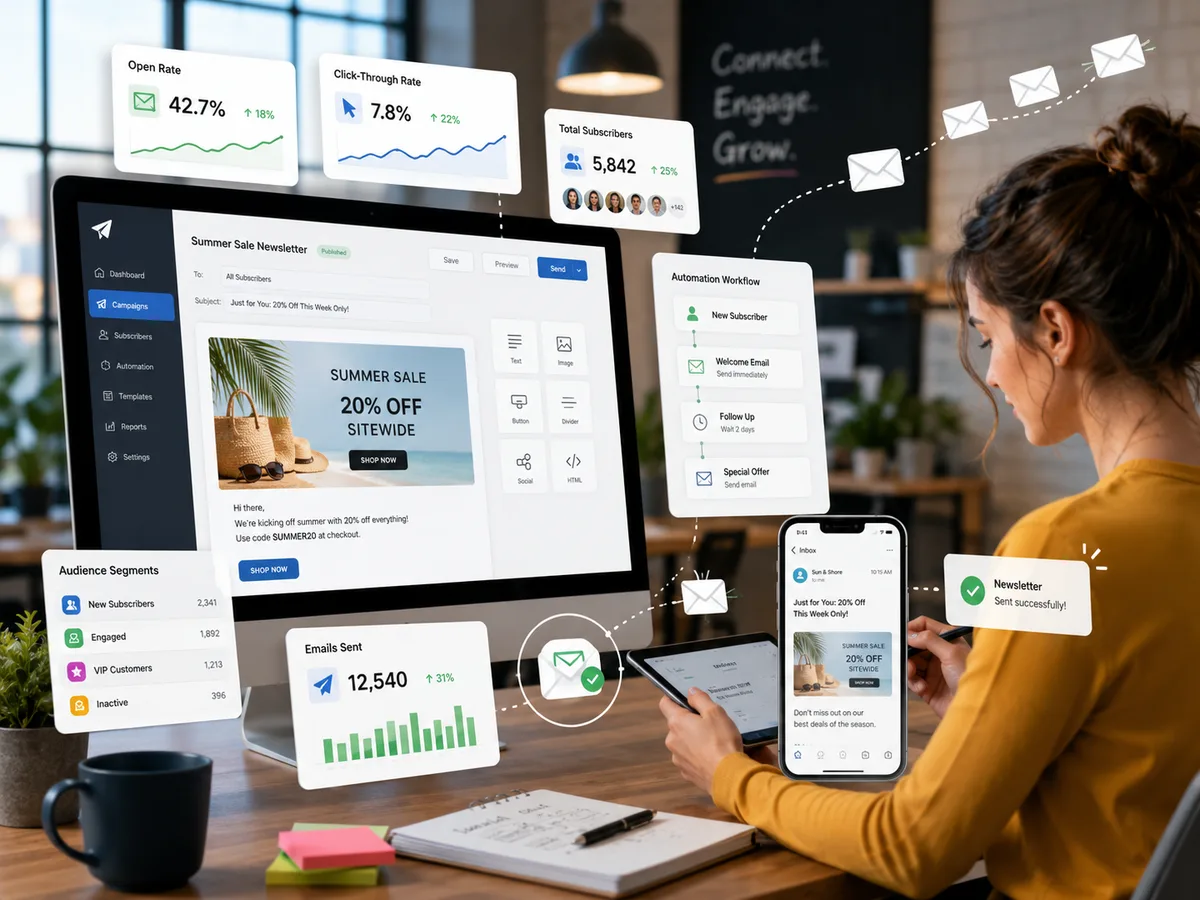
Email marketing consistently delivers a higher return on investment than any other digital marketing channel. Research published by the Data and Marketing Association puts average email ROI at around £36 for every £1 spent. For small businesses with limited budgets, that ratio is worth paying attention to. This guide covers the fundamentals: building a list properly, writing emails people actually open and read, and turning subscribers into customers.
Why email still outperforms everything else
Social media algorithms decide who sees your content. Google decides who finds your website. Email is different: you own the list, and when you send a message it goes directly to the inbox of people who have actively asked to hear from you. There is no algorithm in the way and no pay-to-play dynamic reducing your reach.
The intent of someone on your email list is also meaningfully different from someone who follows you on social media. They gave you their email address, which is a much higher-friction action than clicking a follow button. That friction is a signal. The people on your list have told you, by their action, that they want to hear from you. Treating that relationship with care produces results that social media rarely matches.
Email also compounds in a way that most digital channels do not. A social media post is typically seen once and forgotten. An email from a business someone trusts, arriving consistently over months, builds familiarity and authority. The subscriber who joined your list eight months ago and has read twelve of your emails is far more likely to become a customer than someone who saw a single Instagram post.
Building a list the right way
The quality of your list matters far more than the size. A list of 500 people who actively wanted to hear from you will consistently outperform a list of 5,000 people who vaguely remember signing up for a discount two years ago.
The most effective way to grow a list is to offer something specific and useful in exchange for an email address. Not a generic newsletter, not "sign up for updates", something concrete. A useful guide, a discount code, a free consultation, a checklist, a short course. The more specific and relevant the offer, the better the quality of subscriber you attract.
Placement on your website matters. An email signup form buried in your footer will collect very few subscribers. The same offer in a pop-up triggered after someone has spent 45 seconds on your site, or embedded within a relevant blog post, will collect significantly more. Test both and look at the numbers.
Every subscriber must actively opt in. Under UK GDPR, pre-ticked boxes and implied consent are not sufficient for marketing emails. The subscriber needs to take a positive action to join your list, and you need to keep a record of when and how that consent was given. This sounds like admin, but it also improves list quality because people who actively opt in are more likely to open and engage with what you send.
Subject lines: the only thing that determines whether your email gets opened
The average office worker receives around 120 emails per day. Your subject line has roughly two seconds to earn an open. Everything else in your email is irrelevant if the subject line fails.
The subject lines that consistently produce the highest open rates share a few characteristics. They are specific rather than vague. They create genuine curiosity rather than manufactured urgency. They read like something a person wrote, not something a marketing team approved. "Three things your Google Business Profile is probably missing" will outperform "Improve your online presence today" in almost every test.
Personalisation helps. Emails that include the recipient's first name in the subject line typically see open rates five to ten percentage points higher than those that do not. Most email platforms insert this automatically once you have it captured in your list.
Length matters less than specificity. Short subject lines work well when they create curiosity. Longer ones work when the specificity is compelling. What does not work in either case is vagueness. If your subject line could apply to any email from any business, it needs rewriting.
Writing emails that people actually read
The biggest mistake small businesses make with email content is writing for themselves rather than their subscribers. An email that opens with your company news, your new hire, your recent award or what a great month you have had will be deleted by most readers within the first sentence. Subscribers read emails to get something useful, not to hear about your business.
Start every email from the subscriber's perspective. What problem does this person have? What do they want to achieve? What do they find frustrating about their current situation? Your email should address one of those things directly. Not all three at once, just one, well.
Keep paragraphs short. Long blocks of text in an email look like work to the reader. Two or three sentences per paragraph is usually enough. White space is your friend. People skim emails before they decide whether to read them properly, and content that looks easy to skim gets read far more often than dense blocks of text.
Every email should have one clear call to action. Not three. Not five. One. Do you want them to book a consultation, read a blog post, claim an offer or reply to the email? Pick one and make it obvious. Multiple calls to action compete with each other and typically result in fewer clicks than a single, clear ask.
Frequency, consistency and when to send
The question of how often to email is one most small businesses overthink. The honest answer is that consistency matters far more than frequency. An audience that receives one email every week, reliably, on the same day, builds a habit of opening your emails. An audience that receives five emails in one week and then nothing for a month forgets you exist.
For most small businesses, one email per week is a strong starting point. If you cannot sustain that volume with content that is useful, fortnightly is fine. What you want to avoid is going silent for weeks and then sending a burst of promotional emails when you need more business. That pattern trains your subscribers to disengage.
On timing: in the UK, Tuesday, Wednesday and Thursday mornings between 9am and 11am produce the strongest open rates for most sectors. Friday afternoons and Monday mornings are generally weaker. These are averages and your specific audience may behave differently. Most email platforms show you which days and times produce the best results for your particular list, and that data is worth acting on.
Measuring what matters
Open rate tells you how well your subject lines are working. Click-through rate tells you how compelling your content and calls to action are. Unsubscribe rate tells you whether you are sending too frequently or whether your content is missing the mark. These three numbers, tracked consistently over time, tell you everything you need to know about whether your email marketing is improving.
What most small businesses ignore is the revenue per email metric. Every platform that connects to an ecommerce system can show you how much revenue each campaign generated. For service businesses, tracking which email campaigns produced enquiries is more manual but just as important. Knowing which types of emails produce customers, not just opens, is where email marketing goes from interesting to commercial.
The bottom line
Email marketing works for small businesses that treat it seriously. Build a list of people who actively want to hear from you, give them something useful each time you write, keep subject lines specific and honest, and send consistently rather than in bursts. The businesses that do these four things well tend to find email becomes their most reliable source of repeat business and referrals. The ones that treat it as an afterthought get the results that reflect that.
Ask AI about this topic
Get a personalised answer or ask a follow-up question about email marketing for small businesses.
Frequently asked questions
For most small businesses, one email per week is a good starting point. Consistency matters more than frequency. An audience that receives one good email every week will engage better than one that receives five emails one week and nothing for the next three.
Average open rates vary significantly by sector. In the UK, a 25 to 35 percent open rate is strong for most small business sectors. If your open rate is consistently below 20 percent, the issue is usually with your subject lines, your sender name or the quality of your list.
Yes. Under UK GDPR, you need a lawful basis for sending marketing emails. For most small businesses, this means explicit consent. Subscribers must actively opt in, you must keep records of consent, and every email must include an unsubscribe link that works immediately.
Mailchimp, Klaviyo and Brevo are the most widely used platforms for small businesses. Mailchimp is easiest to start with. Klaviyo is better suited to ecommerce businesses because of its deep integration with Shopify. Brevo is a strong option if cost is a primary concern.