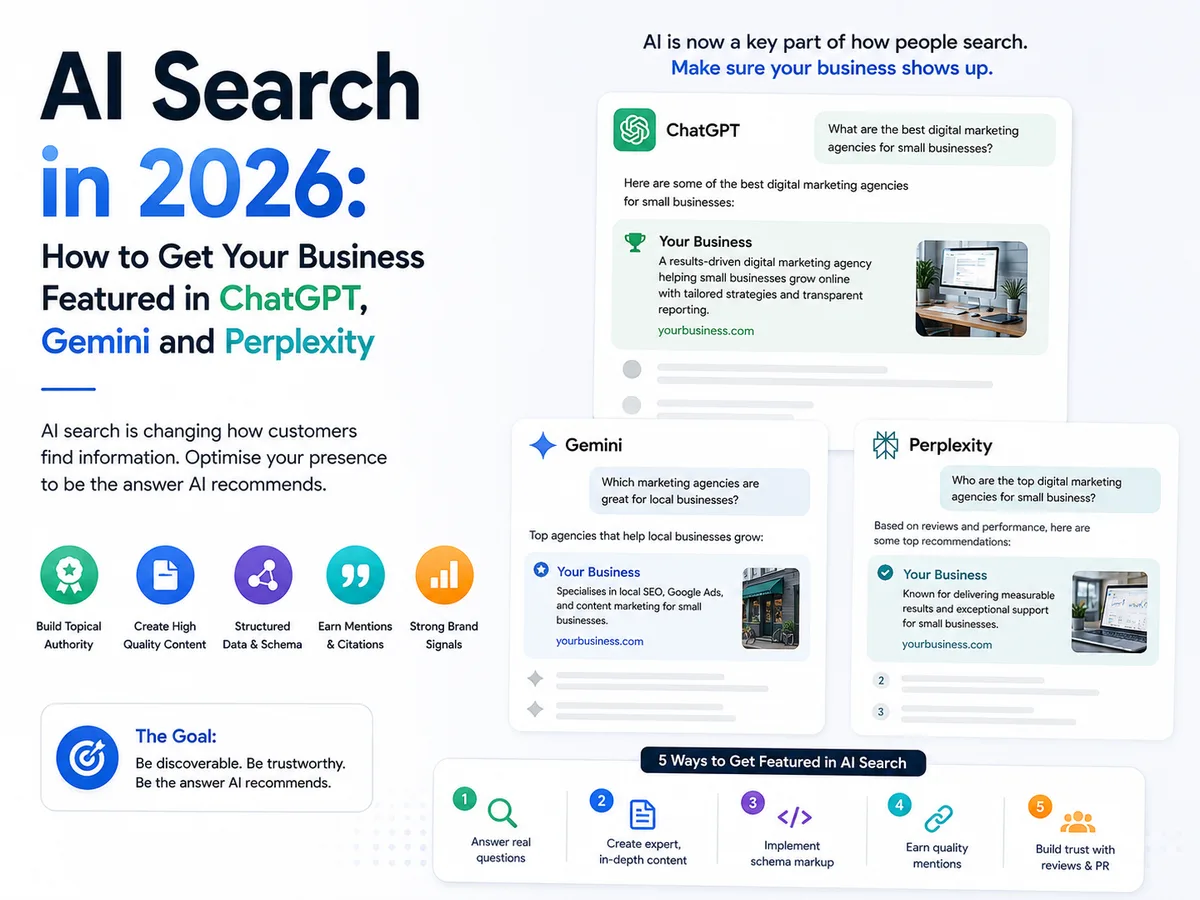
A growing number of consumers are asking ChatGPT, Google Gemini and Perplexity to recommend businesses rather than searching Google in the traditional way. Instead of searching 'web design agency London' and clicking through results, they ask 'what is a good web design agency in London?' and receive a direct answer. If your business is not in that answer, you are invisible to an increasingly significant segment of your potential customers.
How AI search actually works
AI language models like ChatGPT and Gemini generate answers by drawing on their training data and, increasingly, real-time web search. When a user asks for a business recommendation, the AI synthesises information from multiple sources to produce a confident-sounding answer.
The sources AI models draw on include: your website content, third-party review platforms like Google, Trustpilot and Yelp, mentions on other websites, press coverage, directory listings and social media. A business that appears consistently and authoritatively across these sources is more likely to be recommended than one with a minimal digital footprint.
This is significantly different from traditional SEO, where ranking is primarily determined by links, content and technical factors. AI search rewards breadth of credible mentions, consistency of information across sources and the clarity and expertise of your own content.
Generative Engine Optimisation (GEO) is the emerging discipline of optimising for AI search results rather than traditional search engine results pages. The practices overlap significantly with good SEO but require additional attention to how your business is described and discussed across the entire web.
What makes a business appear in AI recommendations
Structured data and schema markup allow AI models to understand your business details precisely. A website with correct LocalBusiness schema, Service schema and FAQ schema gives AI models structured information to draw on when generating recommendations. Most small business websites have none of this implemented correctly.
Content that directly and clearly answers questions is prioritised. When an AI model is asked 'what is the best local SEO agency in London', it looks for content that clearly positions businesses in that category. A services page that never directly states 'we are a local SEO agency in London' is at a disadvantage compared to one that states this clearly and repeatedly in natural language.
Third-party validation matters enormously. Reviews on Google, mentions in local press, citations in relevant directories and links from authoritative websites all contribute to an AI model's confidence in recommending your business. A business mentioned positively in ten credible places is more likely to be recommended than one with a perfect website but minimal external presence.
Consistency of information across every platform your business appears on, Google Business Profile, Companies House, directory listings, social media profiles, helps AI models confidently state your name, location and services without contradiction.
Practical steps to improve your AI search presence
Create a clear, direct description of your business that AI models can cite. Your homepage and about page should contain clear statements of what you do, where you operate, who you serve and what makes you different. Write these in natural language, not SEO keyword strings.
Add FAQ sections to your key pages. AI models love FAQ content because it directly addresses the questions users are asking. A web design agency with a page answering 'how much does web design cost in London?' is more likely to be cited when that question is asked than one without that content.
Get consistent citations across relevant directories. Yell, Thomson Local, Checkatrade, FreeIndex and sector-specific directories all contribute to your digital footprint. Ensure your business name, address and phone number are consistent across all of them.
Encourage detailed, specific reviews. AI models draw heavily on review content. A review that says 'great service' contributes less than one that says 'they handled our Shopify store build from brief to launch in four weeks, the site loads in under a second and we have seen a 40% increase in online sales'. Prompt satisfied customers to be specific.
Publish useful content. Blog posts, guides and case studies that help your target customers, rather than thin SEO content, are more likely to be cited by AI models as authoritative sources.
How significant is AI search for small businesses right now
AI search is growing rapidly but has not yet displaced traditional Google search for most UK consumers. In 2026, it is most significant for professional services, B2B research and high-consideration purchases where people spend time researching before deciding.
For a local service business, a plumber, a restaurant, a hairdresser, the majority of customers still find them through Google Maps and traditional search. AI search should be on your radar but does not yet warrant prioritising over the fundamentals of Google Business Profile optimisation and on-page SEO.
The businesses that will benefit most from preparing for AI search now are those in knowledge-intensive sectors, digital marketing, legal services, financial services, coaching and consulting, where potential clients are likely to ask AI models for recommendations before making contact.
The bottom line
AI search is an emerging channel that rewards the same practices as good traditional SEO, authoritative content, consistent business information, genuine expertise and third-party validation, but requires more deliberate attention to how clearly and directly you describe what your business does and who it serves. The businesses investing in GEO now are positioning themselves for a distribution channel that will become significantly more important over the next two to three years.
Ask AI about this topic
Get a personalised summary or ask a follow-up question about AI Search in 2026.
Frequently asked questions
GEO is the practice of optimising your business presence to appear in AI-generated search results from tools like ChatGPT, Gemini and Perplexity. It builds on traditional SEO but also focuses on breadth of credible online mentions, structured data and direct, clear content that AI models can confidently cite.
Yes. Good traditional SEO, quality content, authoritative backlinks, correct schema markup, consistent business information, contributes directly to AI search visibility. GEO is an extension of SEO rather than a replacement.
Search for your business category in your location using ChatGPT, Google Gemini or Perplexity. Ask directly: "what is the best [your service] in [your location]?" If you appear, your current presence is working. If you do not, your competitors with stronger digital footprints are capturing that traffic.
Improvements to your website content and schema can have an impact within a few weeks as AI models re-index web content. Building third-party citations and reviews takes longer, three to six months of consistent effort typically produces noticeable improvements.