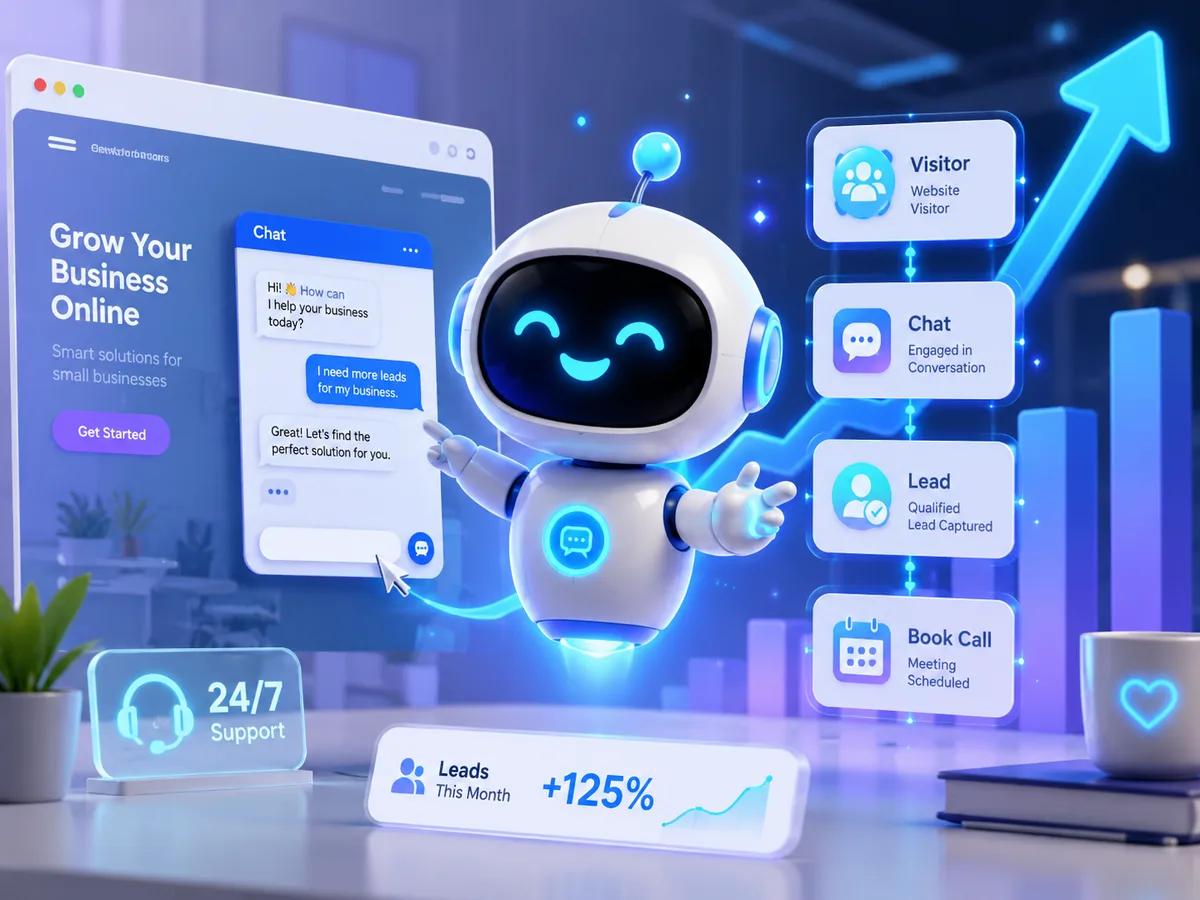
Most small business websites have the same problem. A potential customer arrives at 9pm on a Tuesday, has a question about your services, cannot find the answer and leaves. They might come back. More likely they find a competitor who answers their question. An AI chatbot does not solve every problem a small business has with its website, but it does solve this one, and the commercial impact of capturing those out-of-hours enquiries compounds over time.
What small businesses are actually using chatbots for
The most common use case is not customer service in the traditional sense. It is pre-qualification: gathering enough information from a visitor to determine whether they are a genuine prospect, what they need and whether the timing is right, before a person gets involved.
For a dentist, that might mean collecting the patient's name, the treatment they are looking for, their preferred appointment time and their insurance status before the receptionist calls them back. For a kitchen design company, it might mean establishing the size of the project, the budget range and the timeline before a designer spends an hour on a site visit. For a solicitor, it might mean identifying the type of legal matter and whether it falls within the firm's practice areas before booking a consultation.
In each case, the chatbot is doing the administrative groundwork that would otherwise require a member of staff to be available. When the chatbot hands the lead to a person, that person already has context. The first conversation is more productive. Conversion rates from qualified leads are higher than from cold enquiries.
The second major use case is answering questions that appear repeatedly in your inbox or on your phone. Pricing questions. Opening hours. Location and parking. How to cancel or reschedule. What to bring to an appointment. These questions consume staff time disproportionate to their value. A chatbot trained on your specific business handles all of them without involving a person.
How the technology actually works
Modern AI chatbots for small businesses are built on large language models, the same underlying technology as tools like ChatGPT, but trained specifically on your business's information: your service pages, your FAQ, your pricing, your policies and any additional context you provide during setup.
The chatbot does not just match keywords to scripted responses. It understands natural language, so it can handle the same question phrased in dozens of different ways. It can handle follow-up questions, maintain context across a conversation and escalate to a human when a question is outside its scope or when the visitor explicitly asks to speak to someone.
The quality of the chatbot's responses depends entirely on the quality of the knowledge base it is trained on. A chatbot trained on vague, generic information about your business will give vague, generic answers. One trained on specific, accurate information about your services, pricing, process and common questions will give accurate, useful answers that move the visitor toward booking or buying.
Integration with your existing tools matters. A chatbot that can check appointment availability in real time, add leads to your CRM automatically, or send a confirmation email to the visitor after the conversation is significantly more valuable than one that simply collects contact details in a form. The setup investment to connect these systems properly is worth making.
What chatbots cannot do
Being clear about limitations is important, both for setting expectations when you purchase and for configuring the chatbot correctly so it does not overpromise to visitors.
AI chatbots are not good at handling complaints. A frustrated customer who has had a bad experience needs to feel heard by a person, not managed by an algorithm. The chatbot should recognise complaint situations and escalate them immediately rather than attempting to resolve them through scripted empathy.
They are not good at complex, multi-variable negotiations. If a visitor has a project with unusual requirements, a non-standard budget or circumstances that do not fit your typical service structure, the chatbot should gather the details and hand off to a person rather than attempting to quote or commit.
They require ongoing maintenance. AI models update, your services change, your pricing changes, your policies change. A chatbot trained on information from twelve months ago will start giving inaccurate answers as your business evolves. Monthly reviews to update the knowledge base are not optional if you want the chatbot to remain useful.
Setting one up correctly
The most common mistake in chatbot deployment is rushing the knowledge base. Businesses often give the AI their homepage content, a few service descriptions and expect it to handle everything. This produces a chatbot that sounds plausible but gives incorrect or incomplete answers when visitors ask specific questions.
Build the knowledge base from your real enquiries. Go through the last six months of emails, contact form submissions and phone call logs. Identify the twenty most common questions your business receives. Make sure the chatbot has a specific, accurate answer to every one of them before it goes live. Add the edge cases: the questions that only come up occasionally but cause problems when the chatbot cannot answer them.
Test it properly before launching. Have people who know nothing about your business try to find out whether you can help them using only the chatbot. See where they get stuck, where the answers are unclear and where the chatbot fails to ask the right follow-up question. Every failure in testing is a lost lead in production.
Be honest in the chatbot's introduction. Most visitors know they are talking to an AI and do not object to it, provided it is useful. Presenting the chatbot as a human is both dishonest and often counterproductive when the visitor notices the inconsistency. A simple introduction that names the chatbot and sets expectations for what it can help with builds more trust than a pretence of humanity.
The lead generation impact
The clearest commercial argument for a chatbot is the out-of-hours capture rate. If your business receives enquiries primarily between 9am and 6pm and your website gets meaningful traffic outside those hours, every visitor who arrives in the evening or at the weekend and does not find an answer is a lost opportunity. The chatbot captures those enquiries and puts them in your inbox for Monday morning rather than losing them to a competitor who has a chatbot and you do not.
The second argument is response speed. Research into B2C service businesses consistently shows that the businesses that respond to enquiries within five minutes convert at significantly higher rates than those that respond within an hour. A chatbot responds instantly, every time, regardless of how busy your team is. The speed advantage compounds when your competitors are relying on manual processes.
The third argument is qualification consistency. When humans handle initial enquiries, the questions they ask vary depending on who picks up, how busy they are and how much they know about the enquirer's situation. A chatbot asks the same qualifying questions every time, producing a consistent set of information that makes it easier to prioritise and respond to leads efficiently.
The bottom line
An AI chatbot is not a replacement for good customer service. It is a tool that extends your availability, handles the administrative work of pre-qualifying enquiries and answers common questions without involving your team. For small businesses where every missed enquiry represents real lost revenue, the return on the setup cost is usually clear within the first three months. The businesses that will struggle to justify it are those with very low website traffic or those where every enquiry genuinely requires immediate human involvement from the first contact.
Ask AI about this topic
Get a personalised answer or ask a follow-up question about AI chatbots for your business.
Frequently asked questions
At SearchSoda, AI chatbot setup starts from £1,250 with a monthly maintenance fee from £150. Ongoing costs cover hosting, model usage, updates and monitoring. The total is significantly less than the cost of even a part-time member of staff handling enquiries, and the chatbot is available 24 hours a day.
For most small businesses, an AI chatbot handles the routine enquiries that currently absorb a large proportion of your team's time, freeing them to focus on higher-value work. It is not a replacement for human relationships or complex problem-solving. The best setups use the chatbot to filter and qualify enquiries before passing them to a person.
A well-built chatbot can answer common questions about your services, pricing, availability and location. It can qualify leads by asking the right questions before booking a consultation. It can collect contact details and pass them to your CRM. It cannot handle complaints, manage complex negotiations or replace human judgement on sensitive matters.
A basic chatbot can be set up in a few days. A properly trained chatbot that handles your specific business context accurately takes two to three weeks, including the knowledge base build, testing across common enquiry types and integration with your website and any booking systems.